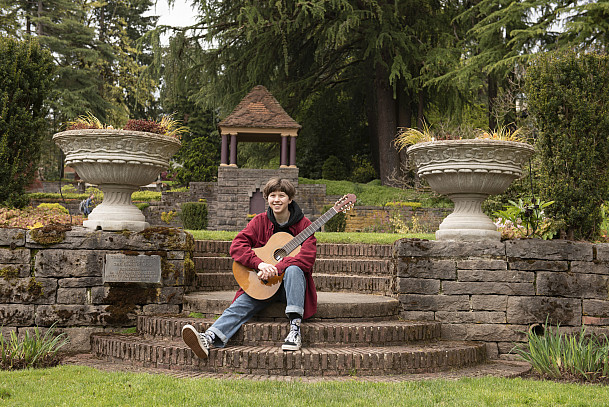
L&C taught me how to work hard and think rigorously. I also learned to write well, quickly, and the fact that my first drafts are readable has really lightened the load for my coworkers.
Research Assistant, Homelessness Research and Action Collaborative at Portland State University
Continuing Studies
University of Michigan Law School
What three words would you use to describe L&C?
Participatory, Alternative, Wide-ranging
Life After L&C
2025 Update
What have you been doing since graduation?
I stayed in Portland. For the past two years, I’ve been working at the Homelessness Research and Action Collaborative at PSU, where I was a research assistant. I’m now a student at the University of Michigan Law School. Since graduating, I’ve also had a lot more free time, so I’ve been rediscovering old hobbies, and trying out new ones.
How did Lewis & Clark prepare you for your job?
L&C taught me how to work hard and think rigorously. It taught me to manage my time and juggle multiple things. I also learned to write well, quickly, and the fact that my first drafts are readable has really lightened the load for my coworkers.
What would you say is the most important thing you learned at Lewis & Clark?
That it’s really, really important to have good friends, and that anything is doable if your friends will do it with you.
How do you stay connected to Lewis & Clark as an alum?
I sing in the Community Chorale.
What did you like or find most interesting about your major?
So much was interesting! I think my favorite part was how easy it is to talk about political science with other, nonpolitical scientists. Everyone has opinions on politics and how the world should be, so it’s really easy to engage people in, for example, conversations about police interrogation or abortion rights. So I was able to talk about what I was learning with my friends and family without boring them (too much).
What did you like or find most interesting about your minor?
I loved getting to problem-solve. Lots of data science is just trying to solve problems using the limited tools you have, and it’s super fun for me.
Where did you find your community on campus?
I was an RA, and met many close friends that way. I helped to run L&C’s improv troupe, which I found quite meaningful and through which I met a lifelong friend. And I was tangentially involved in theater, and still attend lots of theater events.
Life at L&C
What’s your favorite class? How has it expanded your knowledge?
Modern Latin American History with Professor Elliot Young. I went in knowing very little about Latin America, so everything I learned was new and really interesting. The class showed me how one-dimensional my perceptions of Latin America were. Learning about politics in Latin America and how impossible it was to orient political parties there along our simplistic left-right axis stirred my interest in political systems and comparative politics. The class inspired me to take more history classes and political science classes, which I’ve generally enjoyed, and the material we talked about has stuck with me.
What made you want to come to Lewis & Clark?
I was fortunate enough to get to visit before I applied. When visiting, I sat in on a class. I was super nervous finding the class and waiting outside, but one of the students noticed me, greeted me, and let me sit by them for the duration of class. They were discussing Virginia Woolf’s A Room of One’s Own, and I was shocked (pleasantly) by how participatory everyone was. I was really excited to go somewhere where people were excited to learn and to talk to each other about their learning. People are nice here.
How do you describe the liberal arts?
You’re forced to take classes you don’t want to take and then you really like them. The things you learn cover a lot of subjects, so if you’re willing to dive into all of your classes, you graduate knowing how to think about a lot of things. Ideally, the liberal arts teaches you how to be a critical thinker and an engaged member of your society.
Where do you find community on campus?
When I was a first-year student, I was convinced I was going to do theatre here. That’s what I did in high school and I liked it. That did not exactly pan out. Instead, I joined improv. Our troupe was pretty small my first year, and I was definitely a little nervous because of how cool and funny everyone on the team was. We eventually became friends, which is still a high point of my experience. Last year, I became a coleader of improv, which was a lot of work. Trying to keep the troupe alive through the most restrictive part of COVID was hard. This year, we added several really lovely performers who are really nice people. I love improvising with them, and getting to learn about them all outside of improv has been a real source of joy.
Which residence halls have you lived in? How would you describe the hall’s personality? What is/was the best thing about living on campus?
I’ve lived in Copeland, Holmes, and now I’m a resident advisor (RA) in Odell. Copeland was pretty wild. There was always something going on, and no matter how loud I was being I was never the loudest one. It’s noisy and pretty grungy, but I think that’s part of the first-year experience. Holmes was pretty much the exact opposite of Copeland. The building was super nice—it was almost like living in a hotel—but it had a really bad community. No one ever said hi to each other, and there were people on my floor who I still didn’t know in May. This year, I’m an RA in Odell, so my feelings might not be representative, but I really like it. I have a closet, which is great, and I really like my residents. They’re super cool. For me, Odell is the perfect amount of loud. Stuff happens, but people are usually quiet on school nights. I genuinely like living on campus because of how convenient it is. I can get anywhere on campus in under ten minutes, and I like that I run into people. I just wouldn’t see people like that if I lived off campus.
Have you been involved with one of our symposia, as an organizer or participant? What was the experience like? How did the event complement your academic experience?
I have only ever attended symposia. I usually enjoy them and I’m impressed by the amount of work the student organizers put in.
What advice do you have for prospective students?
If you’re able to visit, it really helps you get a vibe on campus.
I took a long time to decide. I tried every possible thing I thought was interesting, I talked to professors and current students, I talked to my friends, and I made a t-chart. If you can, try to pick general education courses that are also potential majors, so that you can explore majors without getting behind on your requirements.
What should incoming students know about sustainability at L&C?
There’s still a lot of work to do.
What have been the biggest challenges you have faced at Lewis & Clark?
The workload can be intense. College work is really a lot harder than high school work. I care a lot about academics and doing well in my classes, so I put in a lot of work. Sometimes there just aren’t enough hours in the day to do all the things I feel like I have to do.
What’s your best Lewis & Clark memory so far?
Lots of high points with my friends. Impossible to pick just one. Lots of high points in classes or at clubs as well.
How has Lewis & Clark changed you?
I’m more extroverted now, and also I’ve tried sports.