
Gemma M. Goette
Lewis & Clark was a wonderful fit, as it offers a calm environment surrounded by greenery, yet is not too far from an urban landscape.

Pronouns
Degree and Class Year
Hometown
Major
Minor
Extracurriculars
Overseas study
What three words would you use to describe L&C?
What’s your favorite class? Why?
Immigration & Asylum Law with Professor Elliott Young was an impactful and fascinating course to participate in. We were given the opportunity to understand the asylum process in the United States through work with current asylum cases. Our research into our assigned cases culminated in drafting country condition reports to assist Professor Young in his role as an expert witness. Applying my historical, political, and cultural knowledge along with my research skills in such a tangible way was incredibly rewarding. Not only did I gain better insight into immigration and asylum law in the United States, but I was also able to help actual individuals in a meaningful way.
What made you want to come to Lewis & Clark?
When applying to colleges, I knew I wanted a significant change of scenery and pace from my life back home in New York City. Lewis & Clark was a wonderful fit, as it offers a calm environment surrounded by greenery, yet is not too far from an urban landscape. Small class sizes, a tight-knit community, and the opportunity to form meaningful relationships with faculty and staff were other elements that drew me to L&C. Additionally, I always knew I wanted to study abroad for at least a year, particularly in Germany, so given Lewis & Clark’s many international opportunities and incredible Year of Study program in Munich, I knew this would be the perfect place for me.
What do you like or find most interesting about your major?
The discussion-based approach taken in many of the history courses at Lewis & Clark is one of the most incredible elements of the major. I have learned a lot from my professors, but also from my peers, who have consistently been so insightful and passionate about the material we are studying. My Reading Colloquium course on American slavery, led by Professor Reiko Hillyer, was a beautiful example of this form of learning and teaching. I left each class session moved, truly in awe of the challenging yet deeply insightful discussions we had just had. The interdisciplinary nature of most history courses is also wonderful, as it has allowed me to understand history from various perspectives and lenses. Such an approach toward the subject also enabled greater flexibility when writing my thesis, as I combined art and architectural analyses with social and cultural histories to produce work I was genuinely passionate about.
Thought-provoking discourse and interdisciplinary work have also been some of my favorite aspects of my German studies major. I have not only learned the technical aspects of the language, but through the study abroad requirement and time spent with the German language assistants, I have engaged deeply with the culture and history of Germany. I have also really appreciated how small and tight-knit the department is, as it has allowed me to build genuine, close relationships with both students and faculty.
What do you like or find most interesting about your minor?
Having grown up in a creative household, with artist parents who emphasized the importance of regular visits to museums and galleries, I have always been drawn to the arts. Though I often gravitate more toward art history over studio art, I love that the minor is combined. Being given the opportunity to create my own work has encouraged a deeper appreciation for the craftsmanship and physical skill that goes into the making of art.
Tell us about your support systems and social outlets on campus: people, activities, clubs, res halls, etc.
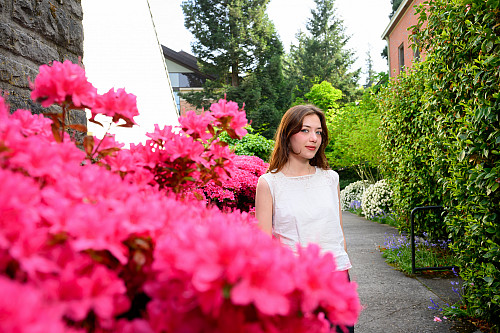

I am very lucky to have kind, intelligent, and creative people in my life who have always been there to support me while on campus. The close friends I have made while at Lewis & Clark have been the best people to study with, collaborate with, create art with, and, most importantly, learn from. They are my social outlets, as well as a great source of inspiration. The students and faculty of the German studies department have also been wonderfully supportive, especially Professors Katharina Altpeter-Jones and Therese Augst. They are two of the most incredible and influential people I have met while at L&C. My German language skills would not be where they are without them, and on a personal level, I have always felt cared for and supported by them.
If you have studied or will study overseas while at Lewis & Clark, how did you choose your program? What did your overseas study add to your L&C experience?
For the entirety of my junior year, I studied abroad in Munich, Germany. My father is from Switzerland, so I always knew I wanted to spend significant time in a German-speaking country to deepen my understanding of the language and culture. When I discovered the Year of Study program and learned that it was a requirement for the German studies major, everything fell into place, and my time abroad was truly transformative. My comfort and skill with the language improved significantly; I found a real community in Germany, and built a stronger connection with my own family nearby in Switzerland.
During my year abroad, I was also awarded a research grant through the program, which allowed me to independently travel through Germany for two months while on our semester break. I traced the history of the Bauhaus, visited examples of German modernist architecture, and conducted interviews with curators and experts on modernism and social housing. This experience allowed me to intertwine all three of my areas of study and laid the foundation for my history honors thesis.
What advice do you have for incoming students?
Don’t shy away from office hours with your professors! The faculty at Lewis & Clark (especially in the history and German studies departments) are some of the most supportive and inspiring people you will meet. Building genuine relationships with my professors has been one of the most rewarding experiences while studying at Lewis & Clark. I also encourage making full use of the Watzek Library. Wander through the stacks, explore interlibrary loan, scroll through the online databases; this is where you will find material that will change the way you think, and transform your academic and personal work! Lastly, I highly recommend finding community through extracurricular activities. These people, the ones who share the same passions and interests as you, will become lifelong friends. And don’t forget to give yourself some grace as you adjust to a new pace and environment. Get off campus, explore Portland, and find inspiration in the world around you.
What’s one of the best spots on campus?
The very best place to be on campus is on the lawn just across from the reflecting pool, especially when the clouds part and Mount Hood peaks out between the trees. It is picturesque and green, and if you find a good semi-secluded spot to sit, you can easily enjoy being outdoors while getting work done. On colder days (or any time of the year, really), Watzek Library is also a wonderful place to be. I have always loved finding a cozy corner in the library to read or study with friends.
What’s your favorite thing about living in Portland?
The natural beauty of Portland and the surrounding area is by far my favorite part about living here. Evergreens and moss, the smell of the rain lingering in the air even after the sun reappears, and the proximity to the Oregon Coast are all things I could never imagine taking for granted.
Why are you planning to double major? What relationship do you see between your studies?
Studying abroad really clarified the relationship between my majors, for as my German language skills improved, I could see the two align. Learning a foreign language has allowed me to access a whole new world of primary and secondary sources, which have been vital to my historical research. My history honors thesis, for example, was largely influenced by my time spent abroad and my ability to read and access German sources. The process of dissecting the way we communicate with one another and thinking critically about my use of language has also helped me become a stronger writer in both German and English.
Not only are the two areas of study compatible academically, but in “real life” as well. These past few years, I have been particularly interested in immigration and public/social housing histories, and while abroad, I was able to focus on these interests within the German context. My understanding of immigration history in the States and Germany, and my ability to speak German, made it easier for me to work directly with refugee communities in Munich. I provided English tutoring sessions through a support organization, and also planned and taught history lessons for those students, directly engaging the relationship between both of my majors.
How are you involved in the arts at L&C?
As an art/art history minor, I have had the privilege of taking numerous arts courses at Lewis & Clark. The studio art and art history professors are some of the best people I have studied under while in college, as they have helped me grow tremendously as an artist, thinker, and individual. Studio art courses with Professors Jess Perlitz and Cara Tomlinson, in particular, have provided wonderful environments for me to break out of my comfort zone, experiment with material, and explore the force and motion of my own body. Additionally, I have worked as a painting studio and lab assistant for a couple of years, which has allowed me to care for and maintain a vital space for students, myself included, to express themselves artistically.

