
News and Events
- NEWS
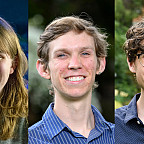
Science Scholars Earn Prestigious NSF Recognition
Two recent alumni have been awarded National Science Foundation Graduate Research Fellowships and a third has received an honorable mention—national recognition that reflects the strength of faculty-mentored undergraduate research at Lewis & Clark.
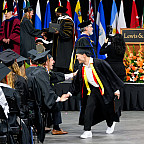
Finding Post-Grad Success
Graduating from Lewis & Clark College means you will earn a bachelor of arts degree that is grounded in critical thinking, written and verbal communication skills, teamwork, and problem solving—all of the essential qualifications you need to succeed in any career.
2026 Project Descriptions for the Rogers Program
Summer science research opportunities

Greg Fredricks – Meritorious Service Award
Emeriti Faculty- Inducted into the LC Athletics Hall of Fame this summer.
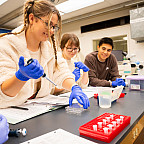
From Lab to Launch
Lewis & Clark’s John S. Rogers Science Research Program gave these young alumni scientists the skills—and the confidence—to soar into graduate programs nationwide.
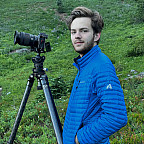
Nicholas Dill Wins College’s Highest Honor
Nicholas Dill BA ’25, who double majored in mathematics and computer science, received the 2025 Rena J. Ratte Award, the undergraduate college’s highest honor. Named for an esteemed professor, the award recognizes a senior whose abilities and commitment have combined to produce work of the highest distinction.
2025 Project Descriptions for the Rogers Program
Summer science research opportunities
- EVENTS
Past Events

Mathematical Colloquium | Joyful Geometry: People and Pictures
Liz Stanhope will talk about how she was hooked into math as an 8th grader, and reflect on her geometrical journey after that. This talk will feature fun examples in geometry and topology, as well as discussion of some of the people who have contributed to Liz’s mathematical career.

Mathematical Sciences Colloquium
Marissa Masden
University of Puget Sound
“Neural Networks, Hyperplane Arrangements, and Topology”
Modern machine learning makes frequent use of a type of function called a ReLU Neural Network. These are simple to describe with a list of matrices and vectors. We discuss how each matrix-vector combination gives us a structure known as a hyperplane arrangement, a collection of (n-1)-dimensional planes in ℝn. Combining the matrices and vectors of a ReLU neural network yields a cell-like structure called a polyhedral complex. I will share how hyperplane arrangements and polyhedral complexes come from ReLU neural networks, how mathematicians study these objects (including a peek into the mathematics of topology, which studies the connectivity of objects), and finally a few experiments that show how we can use these tools to understand what a neural network has learned!
Mathematical Sciences Colloquium
“X-rays and Hyperbolic Geometry”
Sean Richardson
University of Washington
If you take an X-ray image of an object from every angle, can you reconstruct a 3D model of that object? We will investigate the theory and history of this question before moving to an active area of research: an analogous X-ray transform in curved space, which is closely linked to the chaotic dynamics of the geodesics. I will finish by presenting a new partial inversion formula for the case of hyperbolic closed surfaces.


